
Please Scan Me (Field Notes from A.I. Country)
Welcome to A.I. Country. Population: Everyone.

Field Notes from A.I. Country is a series of personal essays about moving to San Francisco in 2025 and trying to understand the strange new social world forming around artificial intelligence: the founders, investors, parties, rituals, delusions, and occasional moments of beauty. The series is inspired by Anna Wiener’s excellent and hilarious 2020 memoir Uncanny Valley, and I hope to write something similar for the A.I. era: part memoir, part comic anthropology, and part record of a city where everyone seems to be building the future and no one can agree on what it is for.
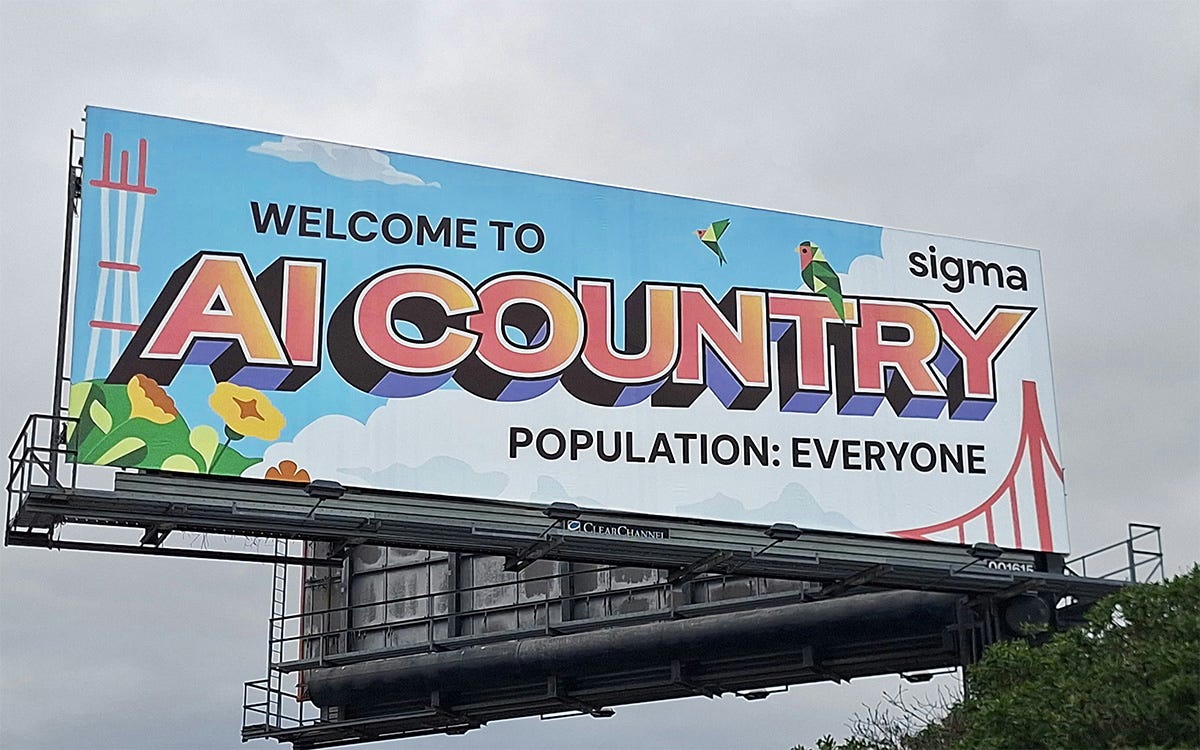
Please Scan Me (October 2025)
I moved from Connecticut to San Francisco in September 2025, following my boyfriend, a physicist who had been hired by an A.I. safety lab-company, a hybrid category that was new to both of us and seemed to contain, in miniature, the whole confusion of the place. I was happy enough to leave my job in a biology lab at Yale, where I made less than $40,000 a year and my responsibilities included beheading pregnant rats and culturing neurons, two activities for which I had no natural gift and even less spiritual resilience. After studying the human condition in poetry seminars, and the molecular mysteries by which the brain generates consciousness, after memorizing pathways, mechanisms, and enough organic chemistry to feel briefly superior at parties, I became a person who entered a windowless room each morning to decapitate pregnant rats with a guillotine—a job no one else wanted, but everyone was very relieved someone else was doing.
My introduction to A.I. had come at the lab, when I trained a small visual model to automate the mind-numbing task I had been given of outlining mitochondrial membranes on electron micrographs. I could not accept that, after years of studying consciousness, language, and the molecular basis of thought, my own consciousness had been reduced to staring at grayscale blobs and painstakingly tracing their little biological borders. The A.I. model made me much more efficient, which meant I could read novels while it performed the parts of my job most likely to make a person lose faith in eyesight, science, and steady employment.
It had taken my boyfriend six months of daily applications to land a job in San Francisco, and he had a PhD and eleven years on me. I had neither the background nor the connections to get hired, so I chose the next most reasonable option: starting a company in an industry I barely understood. I knew nothing about founders, founder psychology, or the particular spiritual discipline required to describe every personal inconvenience as a market opportunity. I did not yet understand that being a founder was less a job than a personality cult with calendar invites, and that I had several disqualifying traits, chief among them a habit of fleeing both annoying people and money, two of the city’s main natural resources. Still, in the absence of employability, I decided to try entrepreneurship.
I was invited to my first exclusive A.I. meetup by my mother’s college ex-boyfriend, which seemed, in retrospect, like an appropriately deranged way to enter Silicon Valley. He was friends with the host and insisted I come, the way people insist you try a restaurant, or meet a man, or expose yourself to a new strain of social anxiety.
The party was in Russian Hill, in a sleek modern house that seemed less like a home than a venue someone occasionally slept in. It had a white kitchen engineered for entertaining, enormous windows, a view over the ocean, a roof deck with a fire pit overlooking the city, and a grand piano placed just conspicuously enough to suggest that culture, too, had been staged for guests.
The sun was setting over the ocean. This was the first thing that made me feel I had made a terrible mistake. Beauty, in San Francisco, often arrived as a trap. You would be standing in some morally confusing room with a venture capitalist in leopard-print pants, and then outside the window the sky would turn an impossible color, as if the city had suddenly remembered it was supposed to be sublime.

On a side table was a framed photograph of the host (a man now in his late 60s) with a young Christina Aguilera.
The guests were already circulating with the anxious confidence of people who believed they were early to the future. There were young founders, mostly men, dressed in the expensive version of not trying: fleece, technical pants, monochrome sneakers, and hoodies engineered for men who wanted to look casual without accidentally seeming poor. They had the lean, underfed look of men who got most of their calories from protein powder and revenge. They stood in small circles saying words like “agentic,” “workflow,” and “verticalized,” each term delivered with the confidence of men who had learned that abstraction, properly funded, could pass for thought.
Everyone was talking about “layers.” There was, I learned, an application layer, an infrastructure layer, an orchestration layer, a memory layer, a trust layer, a safety layer, a social layer, a missing layer, an inevitable layer, and, somewhere above or below all of these, presumably, the human layer (though no one seemed especially interested in that one). Silicon Valley had discovered the layer and, like a toddler with a new word, was applying it to everything. Education was not education but “the learning layer.” Friendship was “the social graph.” Loneliness was “an engagement problem.” A person could begin the evening as a person and, after two conversations, discover she was actually a poorly monetized interface between legacy institutions and emergent behavior.
The first thing I noticed about founder-speak was that it made ordinary life sound both more complicated and less real. No one wanted to say they were making software for schools, hospitals, banks, or customer service departments; they were building “the connective tissue,” “the operating system,” “the intelligence layer,” “the rails.” It was language designed to levitate above the thing itself, as if nouns were little embarrassments left over from a pre-seed world.
There were also women who seemed to have arrived from a different party entirely—Russian, Ukrainian, Latvian, maybe Polish. They wore dresses that made the male founders look even more unfinished, like boys who had wandered into adulthood through a side entrance. I could not tell if the women were bored, amused, or professionally patient. They seemed to understand the room better than anyone else.

I had moved west thinking I might build a company to keep A.I. from ruining education, a goal so sincere it now embarrasses me. I imagined something useful, maybe even humane, though I would not have said humane out loud in a room full of founders. I wanted to help people learn. I had not yet understood that, in Silicon Valley, “helping people” was usually the first sentence of a pitch deck, and the second was where the business model began eating the first.
A man in his thirties approached me and introduced himself as Garrett. He had the air of someone who had already evaluated my usefulness and was generously continuing the conversation anyway. He asked what I did.
I told him that I was thinking about building something in education.
“Education?” he said, as if I had told him I was considering working in a coal mine. “That’s the worst industry.”
“What do you do?” I asked.
He had an A.I. company that replaced call-center workers. He was not replacing workers, exactly. He was building “the conversational layer” for enterprise support, which was a more elegant way of saying that the person you called when your insurance claim had been denied would soon be a machine trained to sound sorry.
He explained this with the serene moral clarity of a person describing a kitchen renovation. His company, he said, automated customer-support conversations for large businesses. The A.I. could handle complaints, returns, account issues, and troubleshooting. It could express sympathy at scale and apologize without needing health insurance.
I asked him how he felt about replacing all those human workers.
He blinked, not offended exactly, but surprised, as if I had introduced an aesthetic concern.
“They don’t like those jobs anyway,” he said. “We’re doing them a favor.”
It was one of those Silicon Valley statements that sounds almost compassionate if you remove all the people from it.
I wanted to ask whether the favor included rent. I wanted to ask whether a person who hated her job might still prefer it to eviction. I wanted to ask whether anyone had ever asked the call-center workers what kind of future they wanted, or whether the future had simply arrived in the form of Garrett, wearing a quarter-zip and monetizing their unhappiness.
Instead I said something noncommittal, because I was new and alone and surrounded by people who spoke in valuations.
He asked why education.
I gave an answer about access, personalization, the possibility of A.I. tutors, the failure of existing schools to meet students where they were. I heard myself becoming earnest, which in that room felt like showing up to a knife fight with a handwritten poem.
He nodded once.
“Yeah,” he said. “But no one pays.”
It turned out he was right, but for the wrong reasons. It would take me several months to discover that “EdTech” was not morally superior to the rest of tech. It was simply better at laundering ambition through the language of care. It had all the usual ingredients: growth fantasies, founder messianism, investor pressure, contempt for the people doing the actual work, and a touching faith in dashboards. The difference was that in EdTech, everyone got to say they were helping children while trying to sell something to a school district with no money.
After a while Garrett held up his phone. A QR code filled the screen. He pushed it toward my face.
I stared at it.
“You can scan me,” he said.
For a moment I thought he meant this metaphysically. The party had already softened the boundaries of normal speech. Scan me could have meant anything (perceive my soul, index my value, retrieve my funding history).
He meant LinkedIn.
I took out my phone and scanned him.
“Well,” I said, “this feels like herding cows.”
He did not laugh, looking at me with the mild disappointment of a man whose networking ritual had been misclassified as agriculture.
Eventually the host emerged.
He was in his late sixties, at the stage of wealth where aging had become less a biological fact than a problem to be solved, and he seemed fully convinced that, with enough money, the body might eventually agree to renegotiate. Every few seconds he touched his hair to make sure it was still obeying him. He wore tight leopard-print pants and a fitted shirt, and moved through the room with the benevolent entitlement of someone accustomed to being forgiven in advance. People made way for him. The young founders straightened. The women smiled with varying levels of commitment.
He welcomed us to his home and said a few words about A.I. The speech had the familiar structure of technological prophecy: everything was changing, nobody understood how much, we were among the few who did, and therefore we had a responsibility to enjoy ourselves in advance of everyone else.
Then he gestured toward a wall where someone had placed a grid of Post-it notes.
The question, written messily in blue marker, was:
Architecture of Immortality: Can A.I. grant us a form of immortality? Is this just an illusion (or fraud)? What are the implications on society?
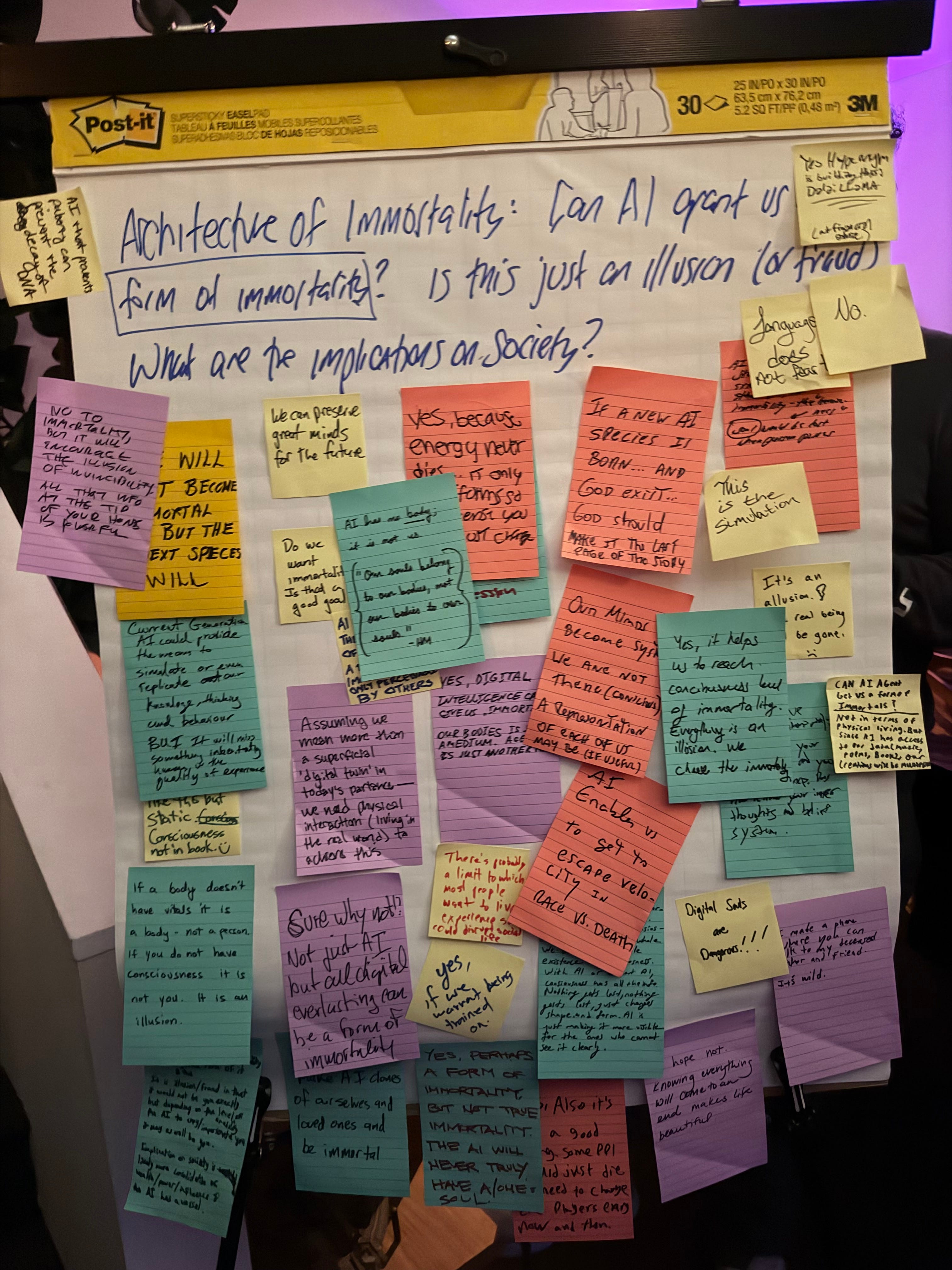
People began writing answers with alarming seriousness. Their faces took on the expression of children asked what they wanted to be when they grew up, except the children were adults and the question was whether they might one day escape death through a subscription product.
The Post-its accumulated quickly. Some were mystical. Some were technical. Some seemed less like answers than early drafts of a cult’s FAQ.
Language does not matter, one person wrote.
This is the simulation, wrote another.
Someone else had written, with admirable directness: No.
There were several versions of yes, but not really; yes, but only as imitation; yes, but only if the model could preserve memories, preferences, loved ones, and some convincing approximation of selfhood. One note suggested that if a body did not have vitals, it was not a person. Another warned that digital souls are dangerous!!! which seemed both correct and like something one should not have to encounter on a pastel sticky note at a rich man’s house.
I stood there holding a marker, trying to decide whether I believed A.I. could grant us immortality, and realizing that I barely believed it could grant us functioning customer service. Around me, people were earnestly debating whether a sufficiently detailed chatbot of your dead grandmother counted as your grandmother, or merely as one more thing you might have to unsubscribe from after a free trial.
There was something touching about it, and something horrible. The room was full of people who had made peace with replacing workers, therapists, teachers, friends, and possibly themselves, but not with dying. Death, apparently, was the one legacy system no one was willing to tolerate.
I thought about writing something noble. Something about embodiment, mortality, grief, the soul, the body, the fact that love depends not only on memory but on presence. Instead I found myself thinking that the whole exercise had the unmistakable emotional texture of a very expensive panic attack. Everyone wanted A.I. to make them immortal, but no one seemed to have considered whether they were currently making a self anyone would want preserved.
Finally, I wrote: I think I already have enough trouble being alive.
I stuck it on the wall between Digital souls are dangerous!!! and someone’s dense explanation of informational continuity, where it looked less like an answer than a cry for help.
For a while I spoke to a woman building an A.I. therapy app. She explained that it would be better than any human therapist because it would be available twenty-four hours a day, remember everything, never judge, and adapt perfectly to the user’s needs. She said this in the tone people use when describing something obviously benevolent, like a vaccine or a dog.
She was building, she explained, “the emotional support layer.” I had previously understood this to mean friends, mothers, therapists, novels, long walks, and the occasional ill-advised phone call, but apparently all of these were fragmented legacy systems.
I thought of every therapist I had ever had: their pauses, their occasionally inconvenient humanity, the way they misunderstood me in ways that were sometimes more useful than understanding me would have been. I thought of the room itself—the rug, the clock, the tissue box—and the strange, necessary knowledge that another person, with a life and problems and private sadness of their own, had put their phone away and was being paid, in part, to listen to me.
“What about transference?” I asked. This was a mistake.
She waved her hand.
“The model can handle that.”
Of course it could. In San Francisco, the model could always handle the thing that had previously made us human.
I also met a woman working on an A.I. platform that connected young people with old people. This was, by far, my favorite idea at the party, perhaps because it sounded less like replacement and more like matchmaking across time. She spoke about loneliness, nursing homes, students, memory, and conversation. For several minutes I felt a small, embarrassing hope. Then she mentioned scaling.
Everything beautiful, I was learning, eventually mentioned scaling.
Later, I found myself upstairs on the roof beside a fire pit, talking to a girl from Latvia. She was my age, maybe younger, with dark hair, piercing blue eyes, and an enviable jawline. She had the long, narrow build of a supermodel, a body so perfectly assembled that I felt shy in her presence. Below us, the city was arranging itself into lights. From Russian Hill, San Francisco looked almost European, which is to say it looked like a place with history, consequences, and public transportation. The air was cold. Everyone had pretended not to be cold for as long as possible, because discomfort, like unemployment, was something the future would presumably solve.
I asked her how she knew the host.
“Oh,” she said. “We’re friends.”
She said it lightly, with no embarrassment and no invitation for follow-up. I nodded as if this explained anything.
A few minutes later the host came onto the roof. He greeted people, touched shoulders, laughed. When he reached the Latvian girl, he leaned down and kissed her on the neck.
She smiled in a way I could not read.
I looked away, which is the coward’s form of discretion.
There are moments in a new city when you understand, suddenly, that you do not understand the rules. Not that you have broken them, exactly, but that the rules are not where you thought they were. In New Haven, power hid itself in private meetings and old houses with bad plumbing. It wore corduroy. It apologized before destroying you. In San Francisco, power stood in a rented or owned mansion wearing leopard-print pants, asking what you planned to do with your freedom.
I went downstairs to find the bathroom.
The hallway was quiet in the strange way party hallways are quiet, as if they exist outside the main economy of performance. Inside the bathroom, someone was bent over the sink doing what I thought was cocaine. They looked up at me in the mirror with the mild irritation of a person interrupted mid-optimization.
I apologized.
I am not sure why.
Back in the kitchen, Garrett was explaining something to two men who appeared to be identical except for their shoes. The Post-it wall had filled up. The piano remained unplayed. Christina Aguilera still smiled from her frame.
I decided it was time to leave.
Outside, the air was cold enough to make me feel briefly superior. I walked downhill toward the part of the city where rideshares could find me. The houses glowed. The bay was dark. Somewhere behind me, people were still discussing the end of work in a room staffed, cleaned, catered, and maintained by workers whose jobs, I suspected, no one at the party was especially eager to automate before the next event.
I had moved to San Francisco thinking I was entering the future. That night, it felt less like the future than a costume party thrown by the present, attended by people who had mistaken money for prophecy.
Still, I had to admit…the view was incredible.
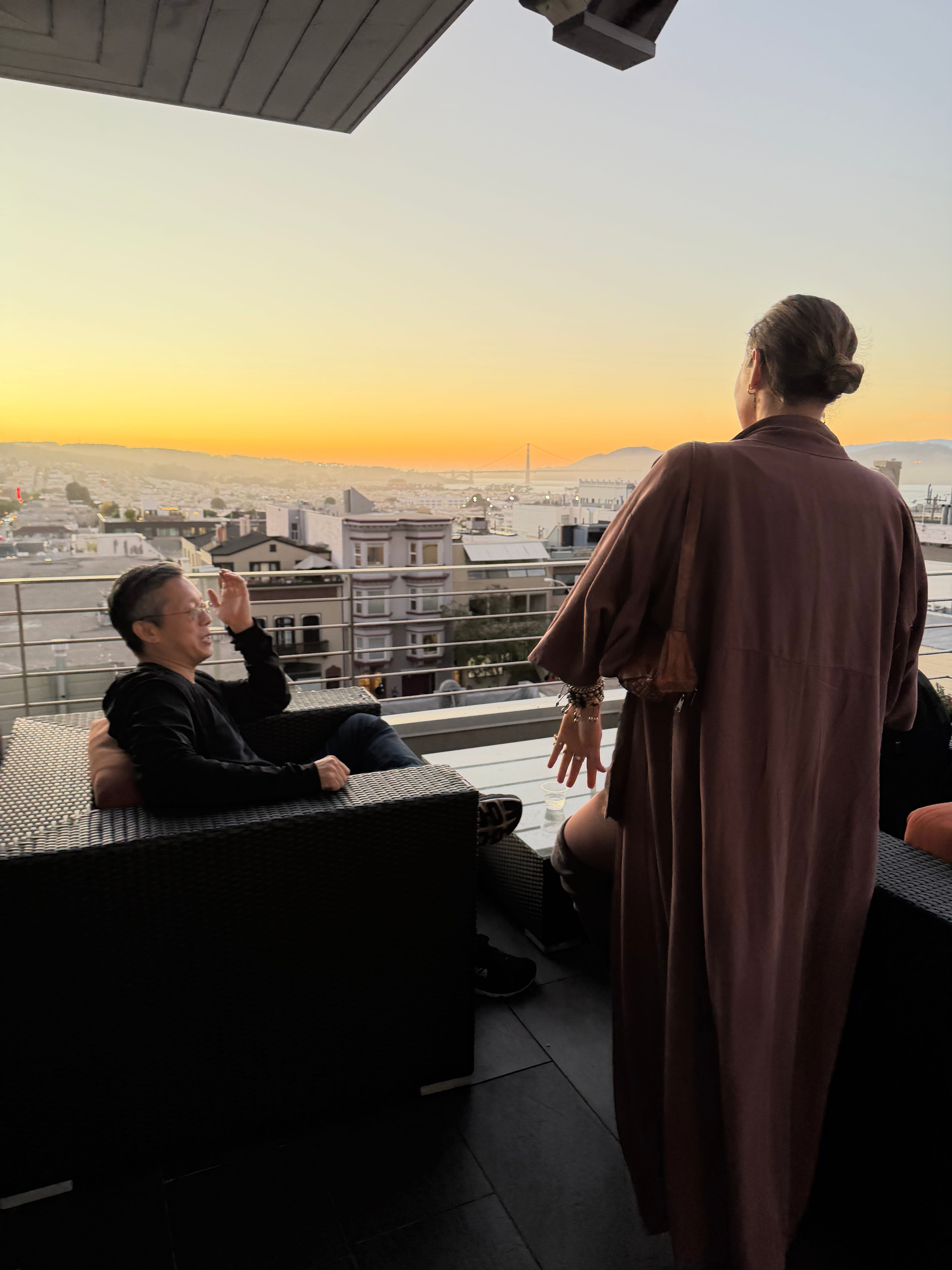
This made me laugh out loud! What a relief!