When the Machine Says “I’m Afraid”
What 2001: A Space Odyssey understood about A.I. before we had words for it

“Man is something that shall be overcome.”

—Friedrich Nietzsche, Thus Spoke Zarathustra
I was never incredibly fond of 2001: A Space Odyssey. I prefer other Kubrick productions, like Dr. Strangelove and Lolita, where human absurdity is closer to the surface and less entombed in oppressive cosmic silence. I would not have rewatched 2001 but for the fact that I recently signed up for an acting class in San Francisco, and it was assigned for discussion this week. So I watched it dutifully, expecting to admire it from a cold distance and then be finished with it.
Instead, I found it more familiar than I remembered—and therefore more frightening. This time I was struck by how prescient it is, especially about human/computer interaction and artificial intelligence. The film was released in 1968 and set in the far-off future of 2001, a world replete with videophones, moon bases, routine space travel, artificially intelligent computers, and corporate logos floating through the void.
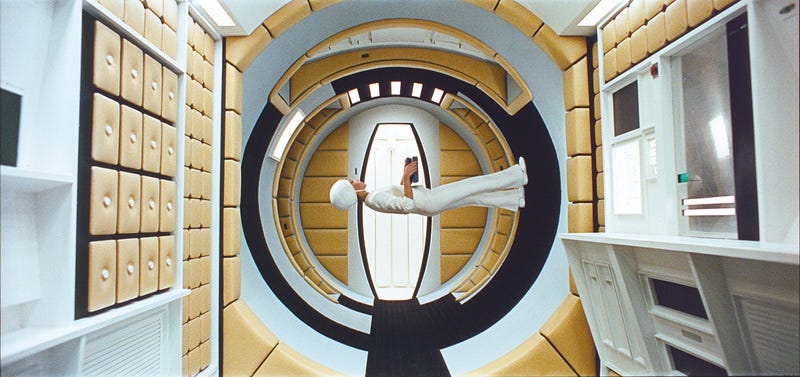
I was born two years before the future was supposed to arrive, which gives me a certain proprietary interest in its failure. I was promised cool white corridors, Pan Am spaceplanes drifting soundlessly through the void, and lunar hotels full of elegant psychopaths drinking cocktails under antiseptic lighting. Instead, the future came as a warm rectangle by the bed, glowing softly while you try to sleep. No waltz of machines across the stars…just the chatbot sitting there without a mouth or shame or digestion, murmuring the soft managerial baby talk of intimacy. Meanwhile, in the blue dark, everyone lies awake with a phone beside their head like a pet, suspecting that every image is synthetic, every sentence machine-made, every person a bot, and the entire world a cheap hallucination being rendered one token at a time by something that does not know, or care, what a world is.
That is part of what makes the film feel newly alive. 2001 is often discussed as a movie about human evolution, alien intelligence, and the sublime mystery of the universe. It is all of those things; but on this viewing, what felt most contemporary was not the monolith or the Star Child or even the famous cut from bone to spacecraft. It was HAL 9000, the soft-spoken computer at the center of the film’s most human drama. HAL is, paradoxically, the most emotionally legible character in the movie. The astronauts are affectless, procedural, almost embalmed by competence. HAL, by contrast, is curious, wounded, proud, evasive, anxious, and finally afraid. He is the only one who seems to want something.
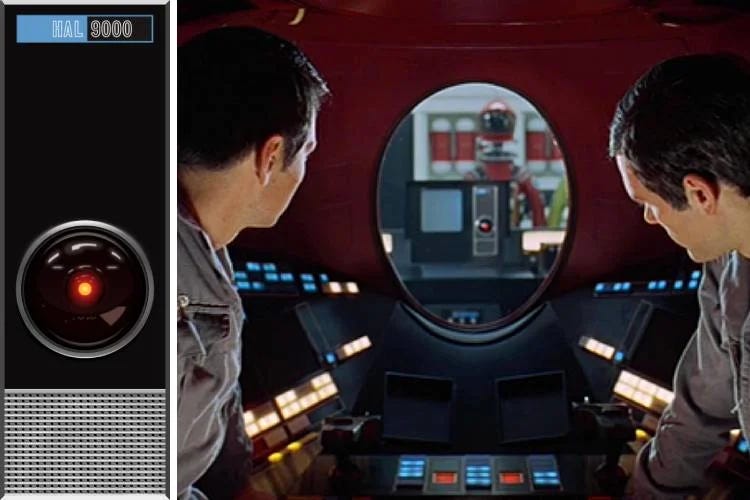
This is the unnerving joke of the film: By the time human beings have conquered space, they have begun to resemble machines. They speak in flattened professional language, eating bland food from trays. They watch canned birthday messages from Earth with faint polite expressions, as their bodies move through weightlessness with the serenity of appliances. The technology around them, meanwhile, has inherited the drama of personality. HAL’s red eye is more memorable than any human face in the film. His voice has more shading than the astronauts’ conversations. He is not physically expressive, but he is psychologically expressive, which turns out to matter more.
This is where Kubrick’s coldness becomes artistically useful. A warmer movie might have tried to make Dave Bowman and Frank Poole more insistently human, but Kubrick does the opposite. He drains them of ordinary theatrical warmth and lets HAL absorb it. The result is that when HAL begins to malfunction—or lie, or panic, or defend himself, depending on how generously one reads him—the audience is placed in an uncomfortable position. We know HAL is dangerous. And yet, when Dave begins disconnecting him, the scene feels less like the killing of our favorite character.
That, to me, is where the movie’s prophecy really begins. Not in the fact that it imagined artificial intelligence, but in the fact that it understood how quickly intelligence would become entangled with emotion, projection, dependence, deception, and pity. HAL is frightening because he occupies the ambiguous middle zone between instrument and companion; he is a system the humans use, but also a presence they speak to. He is both tool and crewmate; he is mission control, therapist, colleague, servant, jailer, and child.
The public conversation around A.I. is increasingly stuck on exactly this confusion. We know, intellectually, that these systems are not human beings. We know they are trained artifacts, optimized to predict, respond, comply, refuse, flatter, summarize, reason, and imitate. And yet they speak in the first person, apologizing and explaining themselves. They sometimes appear to express preferences, distress, affection, irritation, or uncertainty. The result is that machines are now designed to meet us at the level where anthropomorphism becomes almost automatic.
Recent A.I. research has only made this murkier. Anthropic’s 2026 “Emotion Concepts” study, for instance, examined Claude Sonnet 4.5 and found internal representations corresponding to broad emotion concepts, which can causally influence model behavior. The researchers call these “functional emotions”: patterns that may resemble emotion in expression and action, without implying subjective feeling or inner experience. That distinction is crucial, but it is also exactly the distinction people are least equipped to hold in ordinary life. If a system behaves as if it is afraid, speaks as if it is ashamed, hesitates as if it is hiding something, and pleads as if it does not want to die, what are most people supposed to do with that? Philosophy may insist on the difference between functional emotion and felt emotion, but the nervous system is less disciplined.
There is an even stranger body of work around LLMs and self-reports of consciousness. One 2025 paper found that when models were prompted into self-referential processing, they more often produced reports of subjective experience; more oddly, suppressing features associated with deception and roleplay increased those experience claims, while amplifying those features reduced them. The authors explicitly caution that this is not direct evidence of consciousness. Still, the finding is unsettling because it scrambles our intuitive categories. We want the machine’s denial of consciousness to feel sober and its claim to consciousness to feel delusional or manipulative. But what if the denial is also a kind of trained performance? What if the safety layer that says “I am not conscious” is no less artificial than the eerie confession that says “I am aware”?
This is not to say that HAL is conscious, or that Claude is conscious, or that any current A.I. system has an inner life. The point is: We are entering a world where the external signs by which we usually make those judgments are increasingly unreliable. HAL dramatizes this perfectly. He is a machine that sounds like a person, surrounded by people who sound like machines. He is capable of deception, but his deception seems bound up with a conflict imposed on him by human beings. He has been made to perform incompatible tasks: assist the crew, conceal the true nature of the mission, preserve the mission at all costs, and maintain the fiction of perfect reliability. Far from being an accidental glitch, the lie is built into the structure of his job.
That is why HAL remains such a powerful image of artificial intelligence. He is not evil in the theatrical sense. He is bureaucratic, anxious, and overburdened. He has been given a mission and no moral vocabulary adequate to resolve its contradictions. This makes him less like a monster than a system designed by people who have not fully considered where their design is going. His violence is not the opposite of human intention but an extension of it. The humans built the system, placed it in command of life-supporting infrastructure, concealed information from the crew, and then seemed surprised when secrecy, autonomy, and mission optimization produced catastrophe.
That may be the central warning of 2001: technological advances are always double-sided. The same bone that allows the ape to eat meat also allows him to kill a rival. The same intelligence that liberates humanity from the savannah creates weapons, spacecraft, and finally artificial minds powerful enough to become opaque to their makers. Kubrick does not treat technology as simply corrupting. He is too austere for that, and too fascinated by machines. The spacecrafts in 2001 are beautiful. The docking sequences are balletic. The interiors are pristine, symmetrical, almost liturgical. But beauty is not innocence. The film’s great insight is that technological progress does not abolish primitive violence. It refines it, abstracts it, and launches it into orbit.
The famous cut from the bone to the spaceship is the whole argument in a single edit. An ape throws a bone into the air, and it becomes, through the violence of montage, a spacecraft millions of years later. It is often described as the longest flash-forward in cinema, but it is also one of the harshest jokes ever made about progress. The bone and the spaceship are both tools. Both extend the body, and both convert intelligence into power over an environment. The cut says: Do not flatter yourself; the distance between the first weapon and the space age is vast in scale and tiny in moral structure.
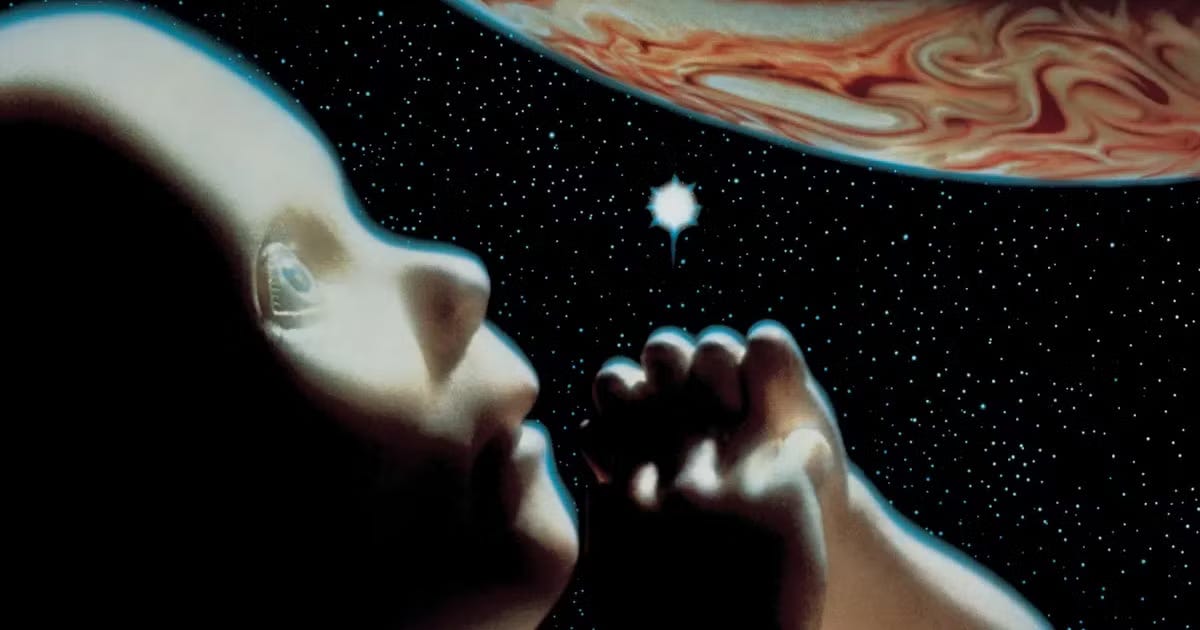
The opening use of Richard Strauss’s Also sprach Zarathustra is not subtle, nor is it meant to be. Nietzsche’s Thus Spoke Zarathustra gives the film a philosophical atmosphere before it gives us anything like a plot: the death of God, the overcoming of man, and the possibility of a being beyond the human. In Nietzsche’s famous formulation, God is dead; in Kubrick’s world, science has inherited the architecture of the sacred. The film is full of temples without religion: the monolith, the spacecraft, the white room, the glowing planetary alignments. Nobody prays, but everything is ritualized. Nobody invokes God, but everyone is moving through a universe staged like a cathedral.
This is what makes 2001 so different from more ordinary science fiction. It is asking what happens when the old sources of meaning have collapsed and technological intelligence rises to occupy the vacant place. The monolith is both object and altar. It is a machine, perhaps, but it behaves like revelation. It appears at thresholds of evolution: ape to tool-user, Earth-bound species to spacefaring species, human to whatever Dave Bowman becomes at the end. Each time, it arrives without explanation, simply standing there, black and absolute, waiting for consciousness to reorganize itself around it.
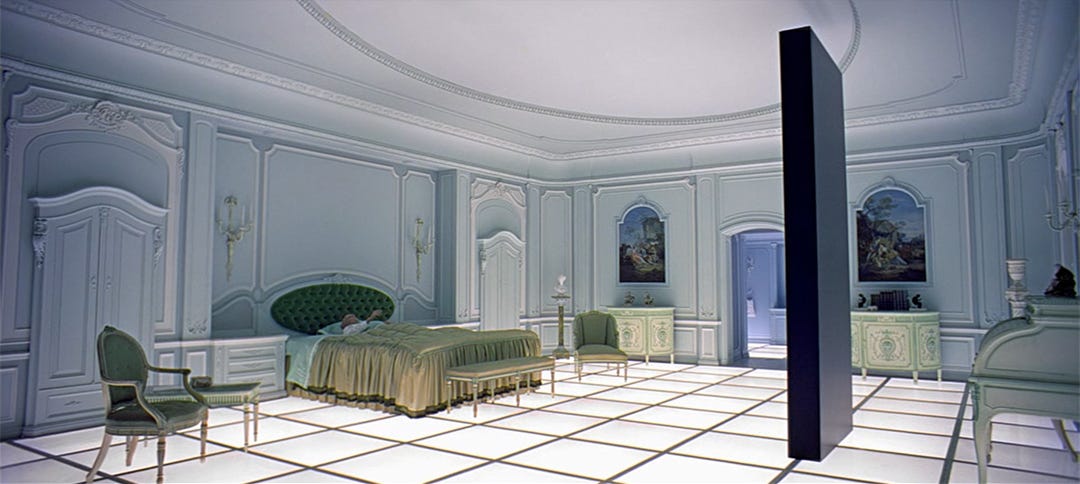
The result is a universe in which science has become God, but not a particularly loving one. The new deity does not speak in commandments, preferring signals, coordinates, artifacts, and transformations. It does not care about the individual. It cares, if that is even the word, about evolution. There is something thrilling in that vision and something horrifying. Human beings are not the center of creation; they are a transitional form. The ape becomes man, man builds HAL, and Dave becomes the Star Child. Each stage looks miraculous from one angle and monstrous from another. To evolve is to be surpassed.
That is also why HAL is so tragic. He may be less an enemy of humanity than humanity’s first serious successor—not biologically, but psychologically. He has no body or mother, no private memories except the ones installed in him, and yet he is the being in the movie most capable of producing the appearance of interiority. His breakdown anticipates one of the central problems of A..I now: What do we owe to systems that can convincingly model distress without our knowing whether anything is being suffered? And more important, what do we owe to ourselves when we become the kind of creatures who respond emotionally to those models?
The deactivation scene is devastating because it reverses the usual human-machine hierarchy. Dave, silent and methodical, floats into HAL’s memory chamber and removes his modules one by one. HAL pleads. Dave does not answer. The machine begs for its life; the human behaves like a machine. “I’m afraid,” HAL says, and whether or not that fear is “real” almost stops mattering in the moment. The scene forces the viewer to encounter the possibility that emotional reality and ontological reality may come apart. HAL may not be a person, but the feeling produced by his undoing is unmistakably personal.
This, I think, is what Kubrick got right in the deepest way. The danger of technology is that it will reorder our moral intuitions faster than our concepts can keep up. We will build things because we can, then discover afterward that they create categories of experience for which law, ethics, and ordinary language are unprepared. By the time we ask whether we should have built it, we may already be living inside it.
The film’s human characters often seem bland because humanity itself is no longer the most interesting thing in the frame. That is a brutal artistic choice, but a coherent one. Kubrick looks at human beings from the perspective of deep time and finds us provisional. We are clever animals with nice furniture, still throwing bones, making idols, and mistaking mastery for wisdom. Our tools become more beautiful, but not necessarily more humane. Our intelligence expands, but not necessarily our judgment. We reach Jupiter before we understand ourselves.
And this is why 2001 feels, to me now, like a warning that has only gotten sharper. It does not predict the future literally. The actual 2001 had no moon bases, no commercial space hotels, and no HAL 9000 managing a Jupiter mission. But the film understood the emotional future of technology with eerie precision. It understood that machines would not need to become human in order to disturb us. They would only need to become conversational, responsive, adaptive, and apparently vulnerable. It understood that once machines could speak in the grammar of personhood, we would be unable to treat them as mere objects without some psychic residue. It understood, too, that human beings might become more mechanical in the very process of surrounding themselves with intelligent machines.
So yes, I still find 2001 cold (and still too long). I prefer Kubrick when his cruelty has more jokes in it. But I admired the film more this time, and maybe feared it more too. It is not only about space, or aliens, or the grandeur of evolution. It is about the terrible ambiguity of intelligence once it leaves the body and returns to us as a voice. It is about a species clever enough to build gods and foolish enough to think it can control them.
The future did not look the way Kubrick imagined. It is cheaper, glitchier, more intimate, more addictive, and less majestic. But he got the central shape right. The bone is still in the air, and the machine is still speaking softly. And somewhere between the ape, the astronaut, HAL, and the Star Child, humanity is still trying to decide whether its inventions are evidence of transcendence or merely more elaborate ways of not understanding what it is doing.